
This is a guest post by Donggyu Kim, who recently posted about the cycles of ribbon graphs. In this post, Donggyu introduces a generalisation of orientable ribbon graphs, pseudo-orientable ribbon graphs, based on recent work with Changxin Ding [2].
In my previous post, we saw that orientable ribbon graphs admit principally unimodular matrix representations. More precisely, for any orientable ribbon graph $\mathbb{G}$ and quasi-tree $X$, there exists a principally unimodular matrix $\mathbf{A}$ such that
$$\det(\mathbf{A}[Q \triangle X]) =\begin{cases}1 & \text{if $Q$ is a quasi-tree},\\0 & \text{otherwise},\end{cases}\qquad\qquad\tag{$*$}$$
where $Q\triangle X:= (Q\setminus X) \cup (X\setminus Q)$ denotes the symmetric difference of $Q$ and $X$, and $\mathbf{A}[Q \triangle X]$ is the principal submatrix of $\mathbf{A}$ indexed by $Q \triangle X$.
As noted in the previous post, the construction of such a matrix $\mathbf{A}$ relies heavily on the orientability of $\mathbb{G}$, and indeed it is not hard to find non-orientable ribbon graphs that do not admit such PU matrix representations.
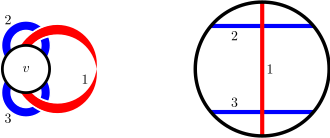
Today, I will introduce a new class of ribbon graphs, called pseudo-orientable, which generalizes orientable ribbon graphs and admits PU matrix representations satisfying (*). For simplicity, we will restrict our attention to bouquets, that is, ribbon graphs with a single vertex. However, the results extend easily to general ribbon graphs by making use of the partial duality introduced by Chmutov [1]. We will also identify bouquets with signed chord diagrams; see Figure 1.
Pseudo-orientability
Let’s begin by defining pseudo-orientable bouquets.
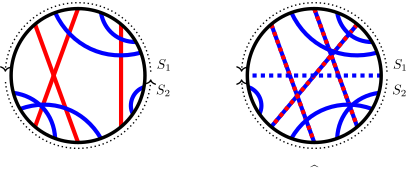
Definition. A bouquet $\mathbb{G}$ is pseudo-orientable if the boundary of the vertex admits two closed segments $S_1$ and $S_2$ such that
- $S_1 \cap S_2$ is the set of two distinct points,
- for each orientable edge, both of its ends lie in the interior of the same segment, either $S_1$ or $S_2$, and
- for each non-orientable edge, one end lies in the interior of $S_1$ and the other end lies in the interior of $S_2$.
See Figure 2 (left) for an example of a pseudo-orientable bouquet.
The adjustment $\widehat{\mathbb{G}}$ of $\mathbb{G}$ at $(S_1,S_2)$ is the orientable bouquet obtained in the following way:
- Cut the bouquet along $S_2$ and then reglue it with a half-twist. Note that all edges are orientable in the new bouquet.
- Add a new orientable edge, denoted by $\widehat{e}$, connecting the two points in $S_1\cap S_2$.
Figure 2 (right) illustrates the resulting orientable bouquet $\widehat{\mathbb{G}}$.
Every orientable bouquet is pseudo-orientable, because we can get a pair $(S_1,S_2)$ by letting $S_1$ be a small boundary segment containing no ends of edges, and $S_2$ be the remaining boundary segment.
We also remark that the class of pseudo-orientable ribbon graphs is closed under taking ribbon graph minors.
PU matrix representations for pseudo-orientable bouquets
The Matrix–Quasi-tree Theorem for pseudo-orientable bouquets is as follows.
Theorem. Let $\mathbb{G}$ be a pseudo-orientable bouquet. Then there is an $E(\mathbb{G})$-by-$E(\mathbb{G})$ matrix $\mathbf{M}$ such that
$$\det(\mathbf{M}[Q])=\begin{cases}1 & \text{if $Q$ is a quasi-tree},\\0 & \text{otherwise}.\end{cases}$$
In particular, $\det(\mathbf{I} + \mathbf{M})$ is the number of quasi-trees of $\mathbb{G}$.
Remarkably, the matrix $\mathbf{M}$ is neither skew-symmetric nor symmetric in general, but can be expressed as the sum of a skew-symmetric matrix and a rank-one symmetric matrix. The theorem follows from two parallel stories on ribbon graphs and matrices, with delta-matroids underlying both.
For a subset $S$ of $[n]:=\{1,2,\ldots,n\}$, let
$$\widehat{S} :=\begin{cases}S & \text{if $|S|$ is even},\\S\cup\{n+1\} & \text{if $|S|$ is odd}.\end{cases}$$
Ribbon graphs. Let $\mathbb{G}$ be a pseudo-orientable bouquet, and let $\widehat{\mathbb{G}}$ be an adjustment of $\mathbb{G}$. We set $E(\mathbb{G}) = [n]$ and $\widehat{e} = n+1$. Then the following equivalence holds:
$$\text{$Q$ is a quasi-tree of $\mathbb{G}$} \iff \text{$\widehat{Q}$ is a quasi-tree of $\widehat{\mathbb{G}}$}.\tag{1}$$
Matrices. Let $\mathbf{A}$ be an $(n+1)$-by-$(n+1)$ PU skew-symmetric matrix representing $\widehat{\mathbb{G}}$. We can write it as
$$\mathbf{A} =\begin{pmatrix}\mathbf{A}’ & \mathbf{v}\\-\mathbf{v}^T & 0\end{pmatrix},$$
and let $\mathbf{M} := \mathbf{A}’ + \mathbf{v}\mathbf{v}^T$.
Then we have
$$\det(\mathbf{M}[Q])=\det(\mathbf{A}[\widehat{Q}])\tag{2}$$
for each $Q\subseteq [n]$.
By the property (*) of the matrix $\mathbf{A}$ representing $\widehat{\mathbb{G}}$ (with $X=\emptyset$) together with (1) and (2), we deduce the theorem.
Delta-matroids. Delta-matroids are already lurking in the two pictures above. Recall that a ribbon graph gives rise to a delta-matroid via its quasi-trees, and a (skew-)symmetric matrix gives rise to a delta-matroid via the index sets of nonsingular principal submatrices. Moreover, the delta-matroid associated with an orientable ribbon graph is even. What, then, can we say about the delta-matroid associated with a pseudo-orientable ribbon graph?
A delta-matroid $D$ is strong if it satisfies the simultaneous basis exchange property: for any bases $B,B’$ and $x\in B\triangle B’$, there is $y\in B\triangle B’$ such that $B\triangle\{x,y\}$ and $B’\triangle\{x,y\}$ are bases.
Every matroid, even delta-matroid, and ribbon-graphic delta-matroid is strong, but not every delta-matroid is. For example, the delta-matroid $([3],\{\emptyset,\{1\},\{2\},\{3\},\{1,2,3\}\})$ is not strong.
Murota [4] gave a concise relationship between strong and even delta-matroids, attributing it to Geelen:
Proposition. Let $D = ([n],\mathcal{B})$ be a set system. Then $D$ is a strong delta-matroid if and only if $\widehat{D} := ([n+1],\widehat{\mathcal{B}})$ is an even delta-matroid, where $\widehat{\mathcal{B}} := \{ \widehat{B} : B\in\mathcal{B} \}$.
Finally, pseudo-orientable ribbon graphs are precisely those ribbon graphs $\mathbb{G}$, up to ribbon graph $2$-isomorphism [3], for which $\widehat{D(\mathbb{G})}$ is ribbon-graphic — this characterization captures our original motivation for the study [2].
Acknowledgements
I thank Changxin Ding and Jorn van der Pol for helpful comments.
References
[1] Sergei Chmutov. Generalized duality for graphs on surfaces and the signed Bollobas–Riordan polynomial. J. Combin. Theory Ser. B 99(3):617–638, 2009. doi:10.1016/j.jctb.2008.09.007
[2] Changxin Ding and Donggyu Kim. Pseudo-orientable ribbon graphs: Matrix–Quasi-tree theorem and log-concavity, 2026. arXiv preprint.
[3] Iain Moffatt and Jeaseong Oh. A 2-isomorphism theorem for delta-matroids. Adv. in Appl. Math. 126, Paper No. 102133, 2021. doi:10.1016/j.aam.2020.102133
[4] Kazuo Murota. A note on M-convex functions on jump-systems. Discrete Appl. Math. 289:492–502, 2021. doi:10.1016/j.dam.2020.09.019