
1. Introduction
In this post I’ll present the following result from a recent paper of Matt Baker, Oliver Lorscheid, myself, and Tianyi Zhang.
Theorem 1. [BLWZ25] The foundation of a matroid is invariant under the operation of segment-cosegment exchange.
This will allow me to discuss three important topics that have not received much attention on this blog:
- Pastures, which are algebraic objects that generalize fields, partial fields, and hyperfields. They were introduced by Baker and Lorscheid [BL21] and are special types of both tracts and ordered blue fields; see [BL21] for details.
- The foundation of a matroid, which is a pasture canonically associated to the matroid that determines its rescaling classes of representations over any pasture. Foundations were introduced by Baker and Lorscheid in [BL21].
- Segment-cosegment exchange, which is an operation that replaces a coindependent $U_{2,n}$-restriction (a segment) with a $U_{2,n}$-restriction of the dual (a cosegment). It was defined by Oxley, Semple, and Vertigan in [OSV00] and has $\Delta$-$Y$ exchange as a special case.
I’ll give some background on these three topics, and then discuss some consequences of Theorem 1. The interested reader can find more details about pastures and foundations in [BL25] and [BLZ25] or from recorded talks by Matt Baker and Oliver Lorscheid, more details about segment-cosegment exchange in Section 11.5 of [Oxl11], and more details about Theorem 1 in [BLWZ25].
2. Pastures
In matroid theory, we typically think of a representation of a matroid $M$ over a field $\mathbb F$ as a matrix over $\mathbb F$ whose column set is $E(M)$ and whose independent sets of columns are the independent sets of $M$. The following observation gives a slightly different perspective: we can represent $M$ with a function from $r$-tuples of $E(M)$ to $\mathbb F$ that satisfies three properties.
Observation 1. A rank-$r$ matroid $M$ on ground set $E$ is representable over a field $\mathbb F$ if and only if there is a function $\Delta \colon E^r \to \mathbb F$ so that:
- $\Delta(e_1, e_2, \dots, e_r) \ne 0$ if and only if $\{e_1, e_2, \dots, e_r\}$ is a basis of $M$.
- $\Delta(e_{\sigma(1)}, \dots, e_{\sigma(r)}) = \textrm{sign}(\sigma) \cdot \Delta(e_1, \dots, e_r)$ for every permutation $\sigma$ of $[r]$.
- $\Delta$ satisfies the 3-term Plücker relations: for all $J \in E^{r-2}$ and $(e_1, e_2, e_3, e_4) \in E^4$,
$\Delta(Je_1e_2)\Delta(Je_3e_4) – \Delta(Je_1e_3)\Delta(Je_2e_4) + \Delta(Je_1e_4)\Delta(Je_2e_3) = 0$.
One direction is immediate: if a matrix $A$ with $r$ rows represents $M$ over $\mathbb F$, then we can choose $\Delta$ to be the function that maps $(e_1, \dots, e_r)$ to the determinant of the corresponding $r$-tuple of columns of $A$, and $\Delta$ will satisfy the three properties. The converse follows from facts about the Plücker embedding of the Grassmannian $\textrm{Gr}(r, \mathbb F^E)$, or it can be proved directly without much difficulty.
From Observation 1 we can note the following: to represent $M$ over $\mathbb F$, we only need to know the multiplicative structure of $\mathbb F$ and the triples from $\mathbb F$ that sum to zero. This means that if we replace addition with suitable axioms for the set of triples that “sum” to zero, we can obtain an abstraction of fields over which we can still represent matroids; this is one way to motivate the definition of a pasture. The underlying multiplicative object will be a monoid with zero, which is a multiplicatively written commutative monoid $P$ with an element $0$ that satisfies $0 \cdot a = 0$ for all $a \in P$; we write $1$ for the unit of $P$ and $P^{\times}$ for the group of invertible elements of $P$.
Definition 1. [BL21] A pasture is a monoid with zero $P$ so that $P^{\times} = P – \{0\}$, together with a set $N_P$ (the null set) of triples from $P$ so that:
- (P1) If $(a,b,c) \in N_P$, then every permutation of $(a,b,c)$ is in $N_P$.
- (P2) If $(a,b,c) \in N_P$ and $d \in P$, then $(ad, bd, cd) \in N_P$.
- (P3) $(a, 0, 0) \in N_P$ if and only if $a = 0$.
- (P4) There is a unique $\epsilon \in P – \{0\}$ so that $(1, \epsilon, 0) \in N_P$.
Pastures generalize fields, partial fields (see Stefan van Zwam’s blog post for a definition), and hyperfields (see Matt Baker’s blog post for a definition). I’ll next list some important examples of pastures.
- If $\mathbb F$ is a field, then $\mathbb F$ is a pasture with $(x, y, z) \in N_{\mathbb F}$ if and only if $x + y + z = 0$. Here $\epsilon = -1$.
- Let $\mathbb F_1^{\pm} = \{0, 1, -1\}$ with the expected multiplication and let $N_{\mathbb F_1^{\pm}}$ consist of all permutations of $(0,0,0)$ and $(1,-1,0)$. Then $\mathbb F_1^{\pm}$ with null set $N_{\mathbb F_1^{\pm}}$ is a pasture called the regular partial field. Here $\epsilon = -1$.
- Let $\mathbb S = \{0, 1, -1\}$ with the expected multiplication and let $N_{\mathbb S}$ consist of all permutations of $(0,0,0)$, $(1,-1,0)$, $(1,1,-1)$, and $(1,-1,-1)$ (this is $(0,0,0)$ and all triples containing a $1$ and a $-1$). Then $\mathbb S$ with null set $N_{\mathbb S}$ is a pasture called the sign hyperfield. Here $\epsilon = -1$.
- Let $\mathbb T = \mathbb R _{\ge 0}$ with the expected multiplication, and $(a,b,c) \in N_{\mathbb T}$ if $\max\{a,b,c\}$ is attained at least twice. Then $\mathbb T$ with null set $N_{\mathbb T}$ is a pasture called the tropical hyperfield. Here $\epsilon = 1$ because $(1,1,0)$ is in the null set.
- Let $\mathbb K = \{0, 1\}$ with the expected multiplication and let $N_{\mathbb K}$ consist of all permutations of $(0,0,0)$, $(1,1,0)$, and $(1,1,1)$. Then $\mathbb K$ with null set $N_{\mathbb K}$ is a pasture called the Krasner hyperfield. Here $\epsilon = 1$.
Many other interesting examples of pastures can be found in the appendix of [BLZ25].
3. Matroids over pastures
By taking Observation 1 and encoding the 3-term Plücker relations with null triples, one can represent matroids over pastures.
Definition 2. [BB19] Given a pasture $P$ and a rank-$r$ matroid $M$ on ground set $E$, a $P$-representation of $M$ is a function $\Delta \colon E^r \to P$ so that:
- $\Delta(e_1, e_2, \dots, e_r) \ne 0$ if and only if $\{e_1, e_2, \dots, e_r\}$ is a basis of $M$.
- $\Delta(e_{\sigma(1)}, \dots, e_{\sigma(r)}) = \textrm{sign}(\sigma) \cdot \Delta(e_1, \dots, e_r)$ for every permutation $\sigma$ of $[r]$.
- For all $J \in E^{r-2}$ and all $(e_1, e_2, e_3, e_4) \in E^4$,
$\Big(\Delta(Je_1e_2)\Delta(Je_3e_4), \epsilon\Delta(Je_1e_3)\Delta(Je_2e_4), \Delta(Je_1e_4)\Delta(Je_2e_3)\Big) \in N_P$.
(Note that $\textrm{sign}(\sigma) \in \{1,\epsilon\}$.) The function $\Delta$ is a Grassmann-Plücker function for $M$.
Matroid representations over pastures have the following attractive properties:
- A matroid is $\mathbb F_1^{\pm}$-representable if and only if it is regular.
- $\mathbb S$-representations of $M$ are orientations of $M$. In this case the Grassmann-Plücker function is called a chirotope.
- $\mathbb T$-representations of $M$ are valuations of $M$.
- Every matroid is representable over $\mathbb K$, via the Grassmann-Plücker function that maps each independent $r$-tuple to $1$ and each dependent $r$-tuple to $0$. Clearly the first two properties hold, and the third follows from basis exchange properties.
There is a natural notion of equivalence for Grassmann-Plücker functions. Let $\Delta_1$ and $\Delta_2$ be Grassmann-Plücker functions for a matroid $M$ on ground set $E$ to a pasture $P$. We say that $\Delta_1$ and $\Delta_2$ are rescaling equivalent if there is a function $c \colon E \to P – \{0\}$ and a constant $d \in P – \{0\}$ so that $\Delta_2(e_1, \dots, e_r) = d \cdot c(e_1) \cdots c(e_r) \Delta_1(e_1, \dots, e_r)$ for all $(e_1, \dots, e_r) \in E^r$. When $P$ is a field, rescaling equivalence classes are projective equivalence classes of matrix representations, and when $P = \mathbb S$, rescaling equivalence classes are reorientation classes of chirotopes.
4. The foundation of a matroid
The foundation of a matroid $M$ is a pasture canonically associated with $M$. The definition relies on the notion of a morphism between pastures $P_1$ and $P_2$, which is a function $f \colon P_1 \to P_2$ that is a homomorphism of the underlying monoids with zero (so $f(0) = 0$, $f(1) = 1$, and $f$ respects multiplication) so that $(f(a), f(b), f(c)) \in N_{P_2}$ whenever $(a, b, c) \in N_{P_1}$. For example, $\mathbb F_1^{\pm}$ has a morphism to every pasture (map $0$ to $0$, $1$ to $1$, and $-1$ to $\epsilon$), and every pasture has a morphism to $\mathbb K$ (map $0$ to $0$ and everything else to $1$).
Pastures and the morphisms between them form a category, and much of the theory of matroids over pastures relies on using tools from category theory to study the category of pastures; this is the perspective that leads to the notion of the foundation of a matroid.
Theorem 2. [BL25] For every matroid $M$ there is a pasture $F(M)$ so that for every pasture $P$, morphisms from $F(M)$ to $P$ are in one-to-one correspondence with rescaling classes of $P$-representations of $M$, functorially in $P$.
The pasture $F(M)$ is the foundation of $M$. Here “functorially in $P$” means that for every morphism of pastures $P_1 \to P_2$ there is a commutative diagram, shown in Figure 1. (For those well-versed in category theory, $F(M)$ represents the functor taking a pasture $P$ to the set of rescaling classes of $P$-representations of $M$.)

There is overwhelming evidence that foundations are natural:
- Every regular matroid has foundation $\mathbb F_1^{\pm}$.
- Every projective geometry with rank at least $3$ over a finite field $\mathbb F_q$ has foundation $\mathbb F_q$.
- $M$ and $M^*$ have isomorphic foundations.
- If $N = M/X\backslash Y$, then there is a morphism from $F(N)$ to $F(M)$.
- The multiplicative group of $F(M)$ is the inner Tutte group of $M$ as defined by Dress and Wenzel [DW89].
- If $F(M)$ is a partial field, it is isomorphic to the universal partial field of $M$ as defined by Pendavingh and van Zwam [PvZ10].
Also, foundations of small matroids can be computed in Macaulay2, so foundations are practically useful in matroid research as well as interesting.
5. Segment-cosegment exchange
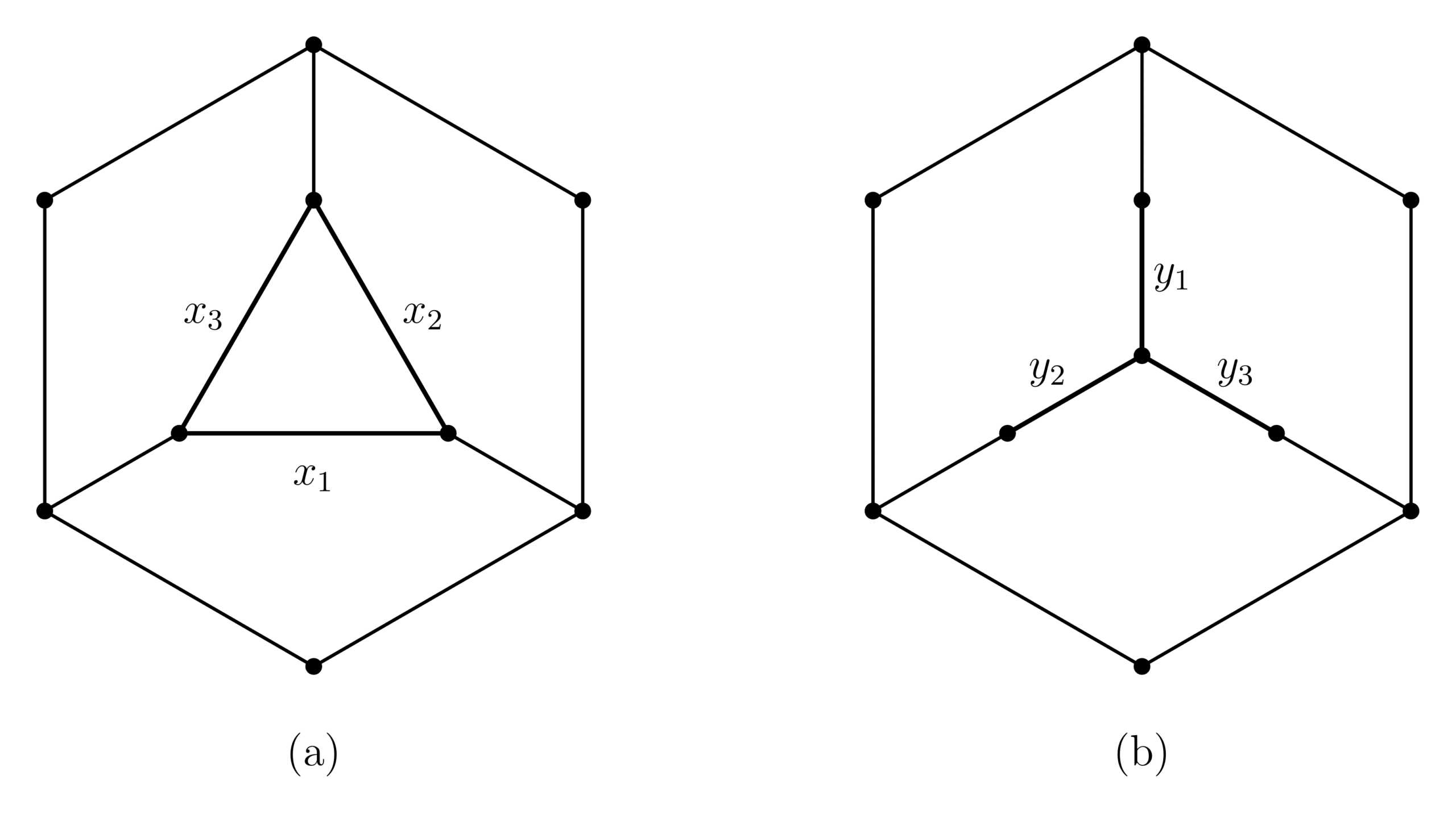
In [BLWZ25], we study how matroid foundations behave with respect to several fundamental matroid operations including 2-sum, parallel connection, and generalized parallel connection, but in this post I will just focus on one: segment-cosegment exchange. I’ll motivate this operation via graph theory. If a graph $G$ has a triangle $T$, the graph obtained from $G$ by adding a vertex $v$ adjacent to each vertex of $T$ and then deleting the edges of $T$ is called the $\Delta$-$Y$ exchange of $G$ along $T$; see Figure 2 for an example. This operation was originally motivated by the study of electrical networks, but also preserves many natural topological properties of graphs, such as linkless embeddability.
In [AO91], Akkari and Oxley generalized $\Delta$-$Y$ exchange to matroids using a gluing operation called generalized parallel connection.
Definition 3. [Bry75] Let $M_1$ and $M_2$ be matroids with ground sets $E_1$ and $E_2$ respectively. If $E_1 \cap E_2 = T$ with $M_1|T = M_2|T$ and $T$ is a modular flat in $M_1$, then the generalized parallel connection $P_T(M_1, M_2)$ is the matroid on $E_1 \cup E_2$ such that $F$ is a flat of $P_T(M_1, M_2)$ if and only if $F \cap E_i$ is a flat of $M_i$ for $i = 1,2$. (A flat $T$ is modular if $(T, F’)$ satisfies the submodular rank inequality with equality for every flat $F’$.)
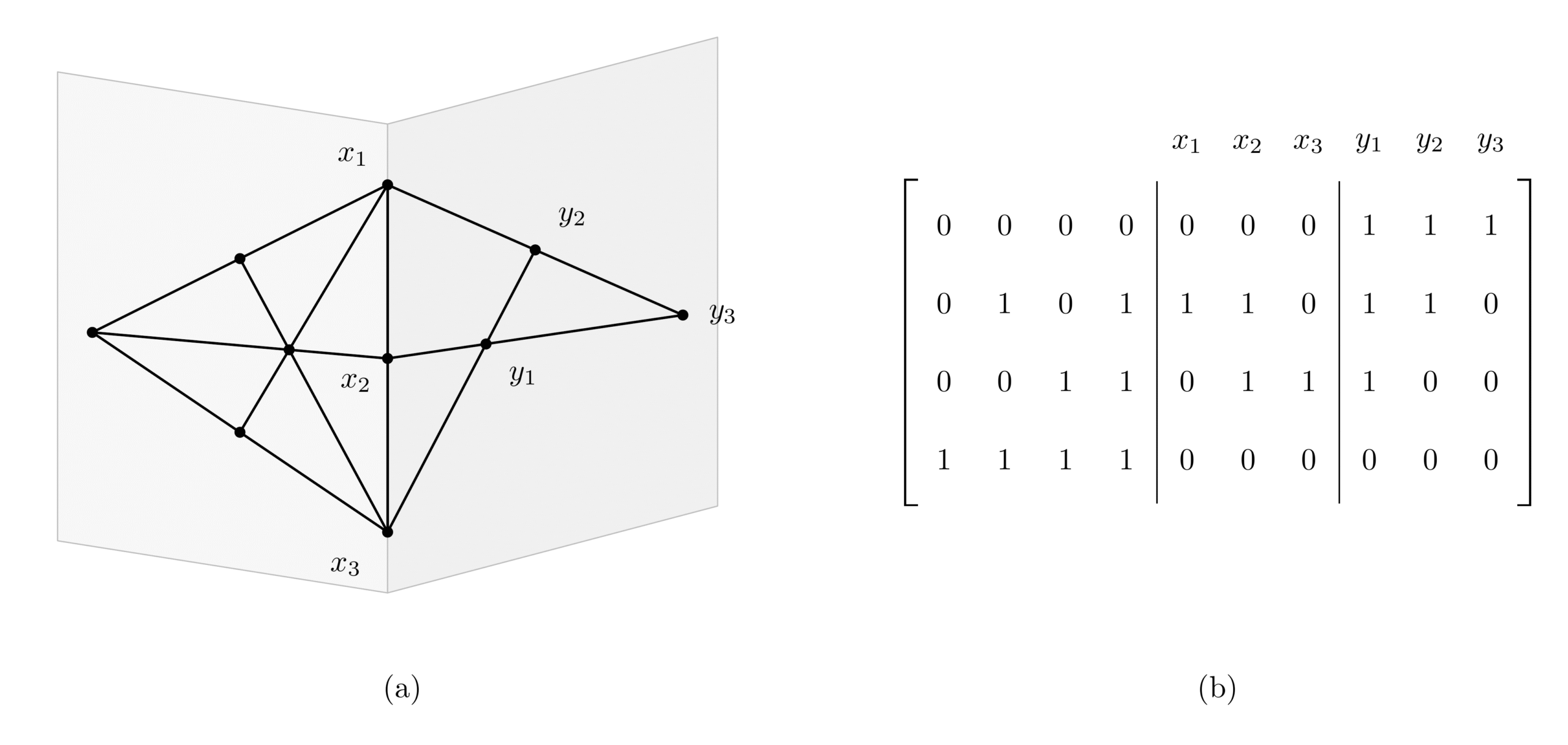
For example, if $T = \varnothing$, then $P_T(M_1, M_2) = M_1 \oplus M_2$, and if $T$ is a point $e$, then $P_T(M_1, M_2)$ is the parallel connection of $M_1$ and $M_2$ with respect to $e$. See Figure 3 for an example of a generalized parallel connection of $F_7^-$ with $M(K_4)$ across a triangle.
Given a matroid $M$ with a triangle $T$, Akkari and Oxley [AO91] defined the $\Delta$-$Y$ exchange of $M$ along $T$ as $P_T(M(K_4), M) \backslash T$. This is well-defined because $T$ is a modular flat of $M(K_4)$, and it directly generalizes $\Delta$-$Y$ exchange for graphs because adding a vertex adjacent to each vertex of $T$ forms $K_4$.
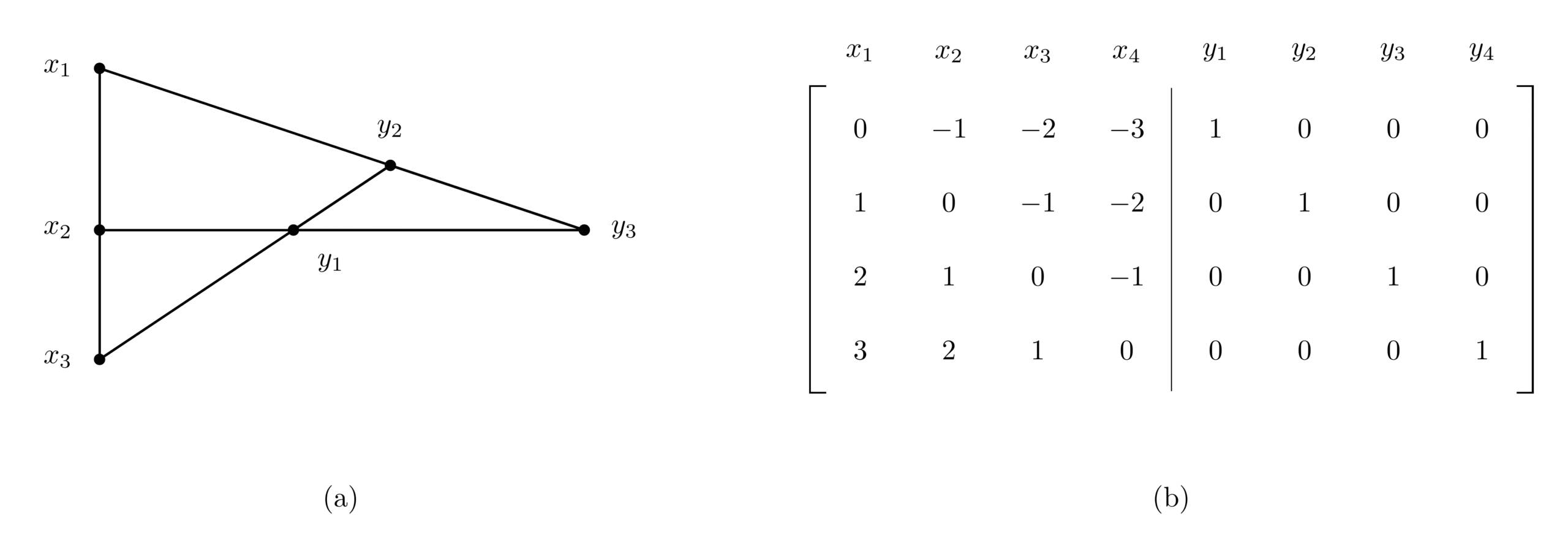
If $T$ is a coindependent triangle of $M$, the $\Delta$-$Y$ exchange of $M$ along $T$ replaces $T$ with a triangle in the dual (a triad). Oxley, Semple, and Vertigan showed in [OSV00] that with a suitable generalization of $M(K_4)$, one can replace a coindependent $U_{2,n}$-restriction with a $U_{2,n}$-restriction in the dual. For $n \ge 3$, let $Y = \{y_1, y_2, \dots, y_n\}$ be a basis of $PG(n – 1, \mathbb R)$ ($n$-dimensional projective space over $\mathbb R$), and let $L$ be a line freely placed relative to $Y$ (so $L$ is disjoint from the span of any $n – 2$ elements of $Y$). By modularity of subspaces of a vector space, for all $i \in [n]$ the hyperplane spanned by $Y – \{y_i\}$ intersects $L$ in a unique element $x_i$. Let $X = \{x_1, x_2, \dots, x_n\}$, and let $\Theta_n$ be the matroid on $X \cup Y$; see Figure 4 for examples. The matroid $\Theta_n$ has the following nice properties:
- $\Theta_3 \cong M(K_4)$.
- $X$ is a modular flat of $\Theta_n$.
- $\Theta_n^*|Y \cong U_{2,n}$.
- $\Theta_n$ is representable over every field $\mathbb F$ with order at least $n$. If $t_1,t_2,\dots, t_n$ are distinct elements in $\mathbb F$, then the matrix $[D | I_n]$ with entry $D_{ij} = t_i – t_j$ represents $\Theta_n$, with $X$ spanned by $\{[1,1,\dots, 1]^T, [t_1, t_2, \dots, t_n]^T\}$. Figure 4 shows a representation of $\Theta_4$ over $\mathbb R$ with $t_i = i$ for all $i \in [4]$.
Since $X$ is a modular flat of $\Theta_n$, one can form the generalized parallel connection along $X$ with any matroid that has a $U_{2,n}$-restriction.
Definition 4. [OSV00] Let $M$ be a matroid with a coindependent set $X$ so that $M|X \cong U_{2,n}$ with $n \ge 3$. The segment-cosegment exchange of $M$ along $X$ is the matroid $P_X(\Theta_n, M) \backslash X$.
Since $X$ is coindependent, one can show that $Y$ is a $U_{2,n}$-restriction of $(P_X(\Theta_n, M) \backslash X)^*$. There is also a dual operation: if $M^*|X \cong U_{2,n}$ and $X$ is independent in $M$, we can take the segment-cosegment exchange of $M^*$ along $X$, and then take the dual; this is called the cosegment-segment exchange of $M$ along $X$. This operation is in fact inverse to segment-cosegment exchange; see [Proposition 11.5.11, Oxl11] for details.
The operation of segment-cosegment exchange behaves well with respect to representability properties and excluded minors. For example, in their paper introducing the operation, Oxley, Semple, and Vertigan use it to show that for every prime power $q$, the class of matroids representable over the finite field of order $q$ has at least $2^{q – 4}$ excluded minors. For more examples, keep reading!
6. The foundation of a segment-cosegment exchange
We have finally arrived at Theorem 1, which I’ll restate below.
Theorem 3. [BLWZ25] Let $M$ be a matroid and let $X \subseteq E(M)$ be a coindependent set such that $M|X \cong U_{2,n}$ for some $n \ge 3$. Then the foundation of the segment-cosegment exchange of $M$ along $X$ is isomorphic to $F(M)$.
By duality, cosegment-segment exchange also preserves foundations. Since the foundation of a matroid determines its rescaling classes of representations over any pasture, Theorem 3 essentially says that segment-cosegment exchange preserves all representability properties for matroids over pastures. This has a number of interesting consequences:
- When $M$ is representable over a partial field $P$, Theorem 3 shows that there is a bijection between rescaling equivalence classes of $P$-representations of $M$ and rescaling classes of $P$-representations of the segment-cosegment exchange of $M$ along $X$; this was proved by Oxley, Semple, and Vertigan [OSV00].
- When $M$ is representable over a partial field, Theorem 3 implies that $M$ and the segment-cosegment exchange of $M$ along $X$ have the same universal partial field; this resolves a conjecture of van Zwam [vZ09].
- Theorem 3 implies that $M$ is orientable if and only if the segment-cosegment exchange of $M$ along $X$ is orientable, which was seemingly not previously known in either direction.
- A matroid is rigid if it has only one valuation, up to rescaling. Theorem 3 implies that $M$ is rigid if and only if the segment-cosegment exchange along $X$ is rigid.
For every pasture $P$, the class of matroids representable over $P$ is minor-closed, and with a bit more work, Theorem 3 also has the following consequence for the excluded minors for $P$-representable matroids, which was proved in the special case that $P$ is a partial field by Oxley, Semple, and Vertigan [OSV00].
Theorem 4. [BLWZ25] Let $P$ be a pasture, and let $M$ be an excluded minor for representability over $P$. Then every segment-cosegment exchange of $M$ is also an excluded minor for representability over $P$.
So, Theorem 3 adds to the overwhelming evidence that the foundation of a matroid is a natural and useful invariant, and I hope this will be enough for the interested reader to start working with foundations!
Statement on AI Usage
Chat GPT-6.1 Sol produced the figures and helped with proofreading. The author takes full responsibility for the content.
References
[AO91] S. Akkari, J. Oxley. Some extremal connectivity results for matroids. J. Combin. Theory Ser. B, 52(2):301-320, 1991.
[BB19] M. Baker, N. Bowler. Matroids over partial hyperstructures. Adv. Math., 343:821-863, 2019.
[BL21] M. Baker, O. Lorscheid. The moduli space of matroids. Adv. Math., 390:Paper No. 107883, 118, 2021.
[BL25] M. Baker, O. Lorscheid. Foundations of matroids, Part 1: Matroids without large uniform minors. Mem. Amer. Math. Soc., 305(1536):v+84, 2025.
[BLZ25] M. Baker, O. Lorscheid, T. Zhang. Foundations of matroids, Part 2: Further theory, examples, and computational methods. Comb. Theory, 5(1):Paper No. 1, 77, 2025.
[BLWZ25] M. Baker, O. Lorscheid, Z. Walsh, T. Zhang. The foundation of generalized parallel connections, 2-sums, and segment-cosegment exchanges of matroids. Comb. Theory, 5(4):Paper No. 12, 38, 2025.
[Bry75] T. Brylawski. Modular constructions for combinatorial geometries. Trans. Amer. Math. Soc., 203:1-44, 1975.
[DW89] A. W. M. Dress, W. Wenzel. Geometric algebra for combinatorial geometries. Adv. Math., 77(1):1-36, 1989.
[Oxl11] J. Oxley. Matroid theory, volume 21 of Oxford Graduate Texts in Mathematics. Oxford University Press, Oxford, second edition, 2011.
[OSV00] J. Oxley, C. Semple, D. Vertigan. Generalized $\Delta-Y$ exchange and $k$-regular matroids. J. Combin. Theory Ser. B, 79(1):1-65, 2000.
[PvZ10] R. Pendavingh, S. van Zwam. Confinement of matroid representations to subsets of partial fields. J. Combin. Theory Ser. B, 100(6):510-545, 2010.
[vZ09] S. van Zwam. Partial fields in matroid theory. PhD thesis, Eindhoven, 2009.